
USTR proposes tariffs of up to 25% on all Indian goods after Section 301 excess-capacity probe; rate would be 17% if India signs a trade deal
USTR found India's manufacturing policies actionable under Section 301 and proposed up to 25% tariffs, or 17% with a deal. Comments due 5 January 2027.
The Office of the United States Trade Representative (USTR) on 25 November 2026 determined that India's policies on manufacturing capacity are unreasonable and burden US commerce under Section 301 of the Trade Act of 1974. It proposed tariffs of up to 25% on all goods of India, with exemptions, or 17% if India reaches a responsive reciprocal trade agreement. Written comments are due on 5 January 2027 and hearings start on 25 January 2027. India's commerce ministry said it is examining the notice and wants concerns settled in bilateral trade talks.
What USTR decided
USTR launched investigations into 16 economies on 11 March 2026 over what it calls structural excess capacity and production in manufacturing. On 25 November it made affirmative determinations for 14 of them: China, the European Union, Singapore, Switzerland, Indonesia, Malaysia, Cambodia, Thailand, Korea, Vietnam, Taiwan, Bangladesh, Japan and India. It has not yet decided on Mexico or Norway.
For India, USTR listed five practices: industrial plans to expand manufacturing, inadequate labour protections, financial repression policies, sustained market access barriers, and failure to address global excess capacity, including through imports and investment from non-market economies. It named pharmaceuticals and medical devices, steel, solar, and information and communications technology as the sectors most affected.
The proposed tariff for India
| Item | USTR proposal for India |
|---|---|
| Headline rate | Up to 25% on all goods of India |
| Basis | Net of existing Section 301 tariffs, with exemptions for certain goods |
| Rate with a trade agreement | 17%, if India reaches a responsive Agreement on Reciprocal Trade |
| Possible adjustments | For duties under other Section 301 and Section 232 actions |
| Comments and hearing requests due | 5 January 2027 |
| Public hearings begin | 25 January 2027 |
Law firm Holland & Knight notes that the 13 non-China notices share a common exemption list. It covers goods already under US Section 232 tariffs, such as steel, aluminium, copper, vehicles and parts, patented pharmaceuticals and semiconductors, plus an annex of products such as certain agricultural goods, energy products and precious metals.
India's response
The Ministry of Commerce and Industry said on 25 November that it has taken note of the notice and is examining it. It said India cooperated throughout the investigation and had told USTR that no sector in India has structural excess capacity. The ministry said India and the US are negotiating a bilateral trade agreement, that trade concerns should be resolved within those talks, and that India remains committed to concluding the agreement at the earliest, in line with the announcement of 2 February 2026 and the joint statement of 7 February 2026.
Related services
Sources
- USTR, 25 November 2026: USTR Makes Determinations and Proposes Actions in 14 Section 301 Investigations
- PIB (Ministry of Commerce and Industry), 25 November 2026: India's statement on the USTR Section 301 decision
- Holland & Knight, November 2026: USTR Proposes Tariffs Following 14 Section 301 Manufacturing Excess Capacity Investigations
Reported by the Refogo News Desk from the official sources above. General information, not legal or tax advice. Spotted an error? Email support@refogo.com; see our corrections policy.
More from Refogo News
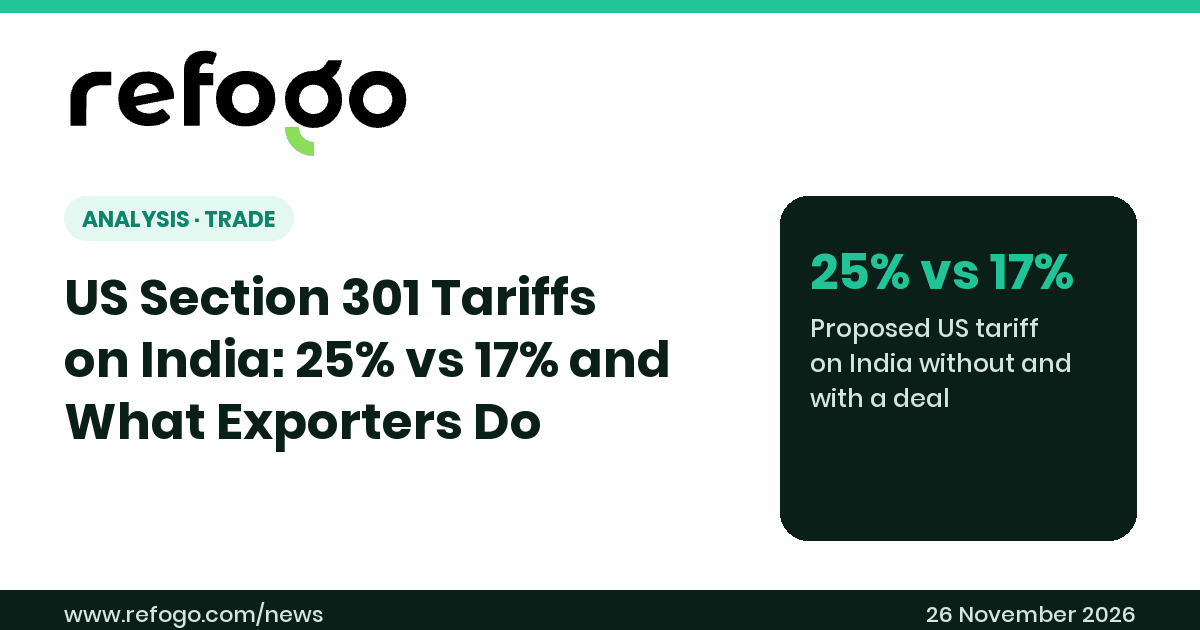
US Section 301 Tariffs on India: 25% vs 17% and What Exporters Do
USTR's Section 301 proposal for India explained: 25% vs 17% rates, comparison with Vietnam and the EU, exemptions, trade exposure and steps for exporters.
RBI Bulletin Nov 2026: Imported Items Drove 18% of October Inflation
RBI's November 2026 Bulletin says India stood out amid uneven global growth, and that imported items drove about 18% of October's retail inflation.
India's Forex Reserves Rose to $737.78 Billion by September 2026: RBI
RBI's 47th half-yearly reserves report shows reserves up from $691.11 bn to $737.78 bn in April–September 2026, with import cover at 9.8 months in June.