
Why RBI eased the daily CRR rule: a ₹1.77 lakh crore liquidity swing, the October forex curbs and what it means for business borrowing and hedging
RBI cut the daily CRR floor to 90% after liquidity swung from surplus to deficit in nine days. What it means for working capital, treasury cash and importers.
On 27 November 2026 the Reserve Bank of India cut the minimum daily cash reserve banks must hold from 99% to 90% of the requirement, effective 1 December. RBI's own data show why: the banking system went from a ₹1,28,939 crore surplus on 17 November to a ₹47,641 crore deficit on 26 November, and the call rate rose above the 5.75% MSF rate. The move unwinds part of an October toolkit that also included a 20% Foreign Exchange Risk Reserve on some rupee derivatives. For businesses, the near-term effects are on short-term borrowing costs, surplus cash returns and import hedging costs.
RBI rarely explains a change to the daily cash reserve rule at length, but its daily money market tables tell the story. In nine days the banking system lost its surplus and began borrowing from RBI. On 27 November the central bank responded by giving banks more day-to-day room with their reserves. Here is what happened, what it means for companies, and what to watch.
What RBI changed on 27 November
Every scheduled bank must keep a cash reserve with RBI equal to a share of its deposits, averaged over a reporting fortnight. RBI also sets a daily floor: the least a bank can hold on any single day. Circular RBI/2026-27/310 lowers that floor from 99% to 90% of the requirement from the fortnight beginning 1 December 2026, citing the current and evolving macroeconomic situation and liquidity conditions. The overall CRR rate does not change; Deccan Chronicle reports it remains at 3%.
A lower floor matters because bank cash needs are lumpy. On days when tax payments, government borrowing or forex operations drain cash, a bank can dip further below its average and make it up later in the fortnight, rather than borrowing at the top of the rate corridor.
A ₹1.77 lakh crore swing in nine days
RBI publishes a daily figure for net liquidity it injects or absorbs. On 17 November it was absorbing ₹1,28,939 crore, meaning banks had more cash than they needed. By 26 November it was injecting ₹47,641 crore. Refogo calculates the swing at about ₹1,76,580 crore. On 25 November the deficit was ₹32,216 crore; Deccan Chronicle notes the system had last been in deficit on 22 June.
Where rates sit in the corridor
RBI's corridor runs from the standing deposit facility (SDF) at 5.25% to the marginal standing facility (MSF) at 5.75%, with the repo rate at 5.50% in between. When cash is plentiful, overnight rates sit near the floor; when it is scarce, they climb toward the ceiling. On 26 November the call money rate averaged 5.76%, and banks borrowed ₹6,225 crore at the MSF window. Business Standard notes that ideally the weighted average call rate should align with the repo rate.
The October toolkit RBI is partly unwinding
The 99% floor was one of several steps RBI took in October. A day after raising it, RBI introduced a Foreign Exchange Risk Reserve (FERR) for authorised dealers: a cash deposit with RBI equal to 20% of the rupee value of certain forex derivative contracts, aimed at the orderly functioning of the foreign exchange market. Business Standard reports the rupee closed at 92.99 per dollar on 27 November, against 92.44 the day before, after gaining more than 2% in November.
- 9 Oct 2026Daily CRR floor raised
RBI raises the floor from 90% to 99%, effective 16 October.
- 10 Oct 2026FERR for user hedges
A.P. (DIR) Circular 26: 20% reserve on INR derivatives above USD 2 million where users buy foreign currency to hedge current account transactions.
- 12 Oct 2026FERR for banks' own hedges
A.P. (DIR) Circular 27: NDDCs to non-residents only for hedging; 20% reserve on banks' own INR derivatives buying foreign currency.
- 26 Nov 2026Deficit
Net liquidity deficit of ₹47,641 crore.
- 27 Nov 2026Floor cut
Daily CRR floor back to 90% from 1 December.
| Measure | Status | Who it touches |
|---|---|---|
| Daily CRR floor | 99% from 16 Oct; 90% from 1 Dec 2026 | Scheduled banks; indirectly, borrowers |
| CRR rate | 3%, unchanged | Scheduled banks |
| FERR on user hedges (Circular 26) | In force; 20% of notional, contracts above USD 2 million | Importers and others buying dollars forward via banks |
| FERR on banks' own hedges (Circular 27) | In force; 20% of notional | Authorised dealer banks |
How much room the change creates
RBI data put banks' average daily CRR requirement for the fortnight ending 30 November at ₹8,29,343 crore. Nine percentage points of that is about ₹74,641 crore of extra day-to-day flexibility (Refogo calculation). That is not new money: banks must still meet the average. Business Standard cites treasury officials estimating about ₹50,000 crore will be released in practice.
The durable figure is a reminder that the squeeze is mostly a frictional, day-to-day one: RBI reported a large durable surplus at end-October, while daily liquidity flipped in late November.
What it means for businesses
- Working capital: lines priced off T-bill or money market benchmarks can reprice faster than repo-linked loans. Check your sanction letters to see which benchmark applies and how often it resets.
- Surplus cash: overnight and liquid fund returns tend to rise when the call rate sits near the MSF. Finance teams should compare these with bank fixed deposits before rolling over.
- Importers: the 20% FERR that banks deposit with RBI on large forward dollar purchases can show up in forward pricing. Ask your bank for the all-in cost on contracts above USD 2 million; RBI treats splitting contracts across transactions or banks to avoid the threshold as a violation.
- Exporters: a rupee near 93 per dollar affects realisation. Track receivables against FEMA timelines and follow a hedging policy rather than timing the market.
What to watch next
Business Standard reports that RBI is widely expected to raise the repo rate by 25 basis points at its policy decision next week. Watch for three signals: whether the call rate falls back toward 5.50% once the 90% floor applies from 1 December; how much RBI injects through repo auctions; and any change to the FERR. Refogo will report the policy decision when it is announced.
Refogo's team can review your loan terms, forex hedging paperwork and FEMA filings.
Related services
Sources
- RBI, Change in Daily Minimum Cash Reserve Maintenance Requirement (RBI/2026-27/310), 27 November 2026
- RBI, Change in Daily Minimum Cash Reserve Maintenance Requirement (RBI/2026-27/290), 9 October 2026
- RBI, A.P. (DIR Series) Circular No. 26: Foreign Exchange Risk Reserve, 10 October 2026
- RBI, A.P. (DIR Series) Circular No. 27: Risk Management and Inter-Bank Dealings, 12 October 2026
- RBI, Money Market Operations as on November 26, 2026
- RBI, Money Market Operations as on November 17, 2026
- RBI, Result of the 3-day VRR auction held on November 27, 2026
- Business Standard, RBI restores 90% daily CRR requirement for banks as liquidity tightens, 27 November 2026
- Deccan Chronicle, RBI Eases Daily CRR Maintenance To 90% As Banking Liquidity Slips Into Deficit, 27 November 2026
Reported by the Refogo News Desk from the official sources above. General information, not legal or tax advice. Spotted an error? Email support@refogo.com; see our corrections policy.
More from Refogo News

CBIC Corrigendum Restores 2 GST Cancellation Grounds in Rule 21
G.S.R. 1005(E) adds back two Rule 21 grounds left out of Notification 05/2026: no business at the declared place, and invoices issued without supply.
RBI Lets Banks Put Debit Holds on Mule Accounts From July 2027
RBI's KYC amendments of 27 November 2026 set a time-bound process for debit holds on suspected mule accounts, with prompt notice and a 7-day reply window.
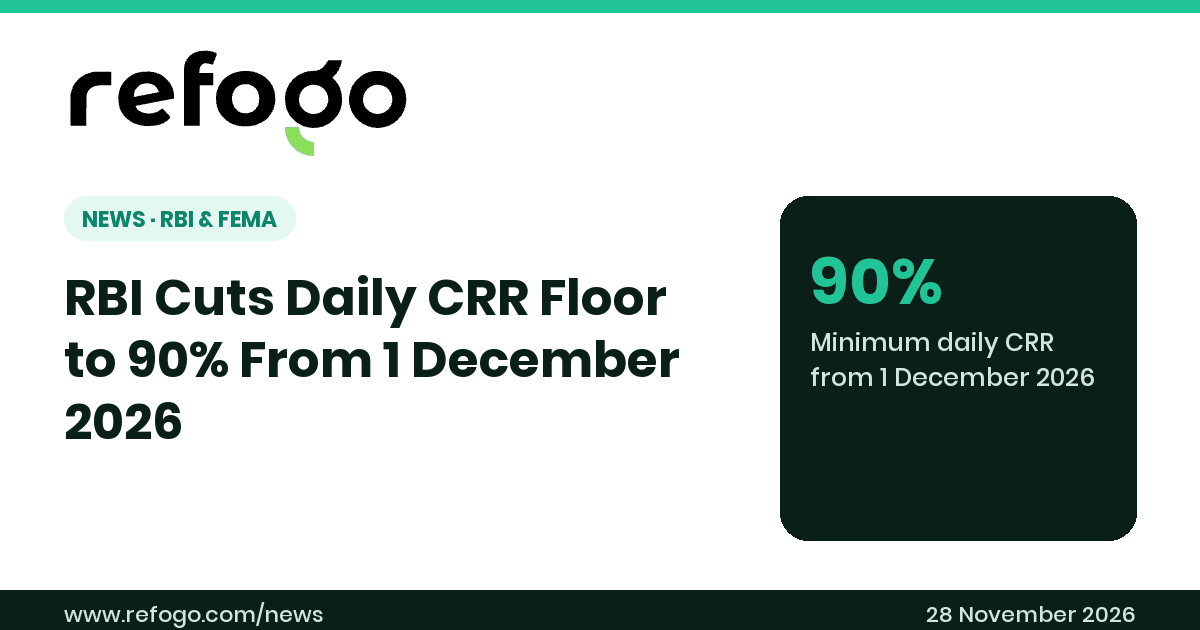
RBI Cuts Daily CRR Floor to 90% From 1 December 2026
RBI circular of 27 November 2026 lets banks keep 90% of required CRR on any day, down from 99%, as system liquidity slipped into a ₹47,641 crore deficit.
Common questions
Did RBI cut the CRR rate on 27 November 2026?
No. The CRR rate is unchanged. RBI lowered only the minimum share of the requirement banks must hold on any single day, from 99% to 90%, from the fortnight beginning 1 December 2026. Banks must still meet the full requirement on average.
Why does a liquidity deficit matter to a small business?
When banks are short of cash, overnight and short-term rates rise. Loans linked to money market or T-bill benchmarks can reprice upward, and banks may be slower to extend fresh working capital. A deficit also lifts returns on short-term deposits and liquid funds.
What is the Foreign Exchange Risk Reserve?
It is a cash deposit authorised dealer banks must keep with RBI, equal to 20% of the rupee value of certain forex derivative contracts, introduced on 10 and 12 October 2026. For customers it applies to INR contracts above USD 2 million where the user buys foreign currency to hedge current account transactions.